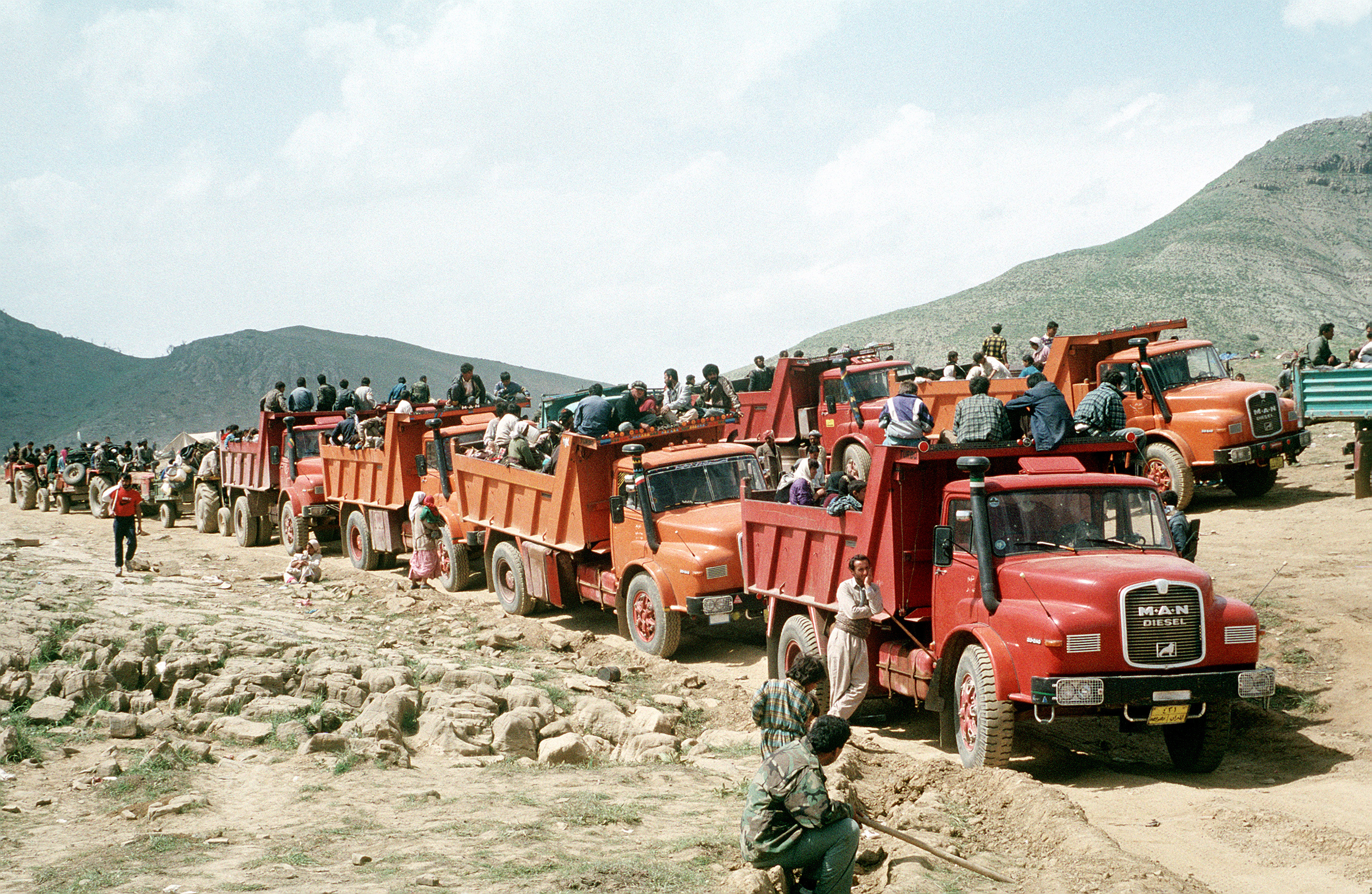
Iraqi refugees during the Gulf War, April 1991. U.S. federal government.
Pre-Invasion Displacment
Before the US invasion of Iraq in 2003, Iraq had faced multiple displacement crises. Driven by the political and social dynamics of Saddam Hussein's regime, many ethnic and sectarian groups were targeted and many of these groups fled in fear of persecution at the hands of the regime. One example of this is the regime's campaign against the Kurdish population of Northern Iraq. The use of violence to forcibly suppress separatist movements caused a large number of Kurdish Iraqis to flee the north into neighboring countries, as seen in the previous image.

Young Iraqi refugees in Syria, June 2012. Photo by James Gordon.
US Invasion
When the US invaded, many already fragile institutions collapsed, leaving a vacuum of power and many Iraqis without proper support. This vacuum was quickly filled by insurgent groups that took up arms against US forces. Fighting between these groups and the occupation prompted many to leave their homes and seek refuge in parts of the country that were less affected by the violence.
In the immediate aftermath of the invasion, sectarian tensions between Sunni and Shia communities escalated dramatically (in large part due to the mismanagement of the occupation). This culminated in widespread sectarian violence, particularly after the 2006 bombing of the al-Askari mosque. Sunni and Shia militias engaged in retaliatory attacks, often targeting civilians, which drove people to flee mixed-sect areas in search of safety within territories dominated by their own sect.

Displaced people wait to enter the Kurdish-controlled region of Iraq, October 2017. Photo by Ivor Prickett / The New York Times.
New Waves of Displacement
Many displaced Iraqis started to return to their homes in 2012 and 2013, with the number of IDPs dropping from around 2.8 million in 2010 to 2.1 million by 2013. However, the instability of the disintegrated Iraq military led to the rise of the brutal so-called "Islamic State" (IS). The extremist group's quick advances eventually erupted into a full-scale civil war in 2014. Their quick territorial expansion forced millions of Iraqis to flee their homes. This conflict compounded the displacement crisis that had been ongoing since the U.S. invasion in 2003, making Iraq's humanitarian crisis even more dire. By the end of 2014, the number of internally displaced people in Iraq reached 3.3 million.
The displacement crises in Iraq, particularly during the Iraq Civil War (2014-2017), are part of a broader pattern of cyclical displacement in the region. Many Iraqis, displaced in the initial invasion, were able to return to their homes just to be forced to leave again. For some, this has been their whole lives.
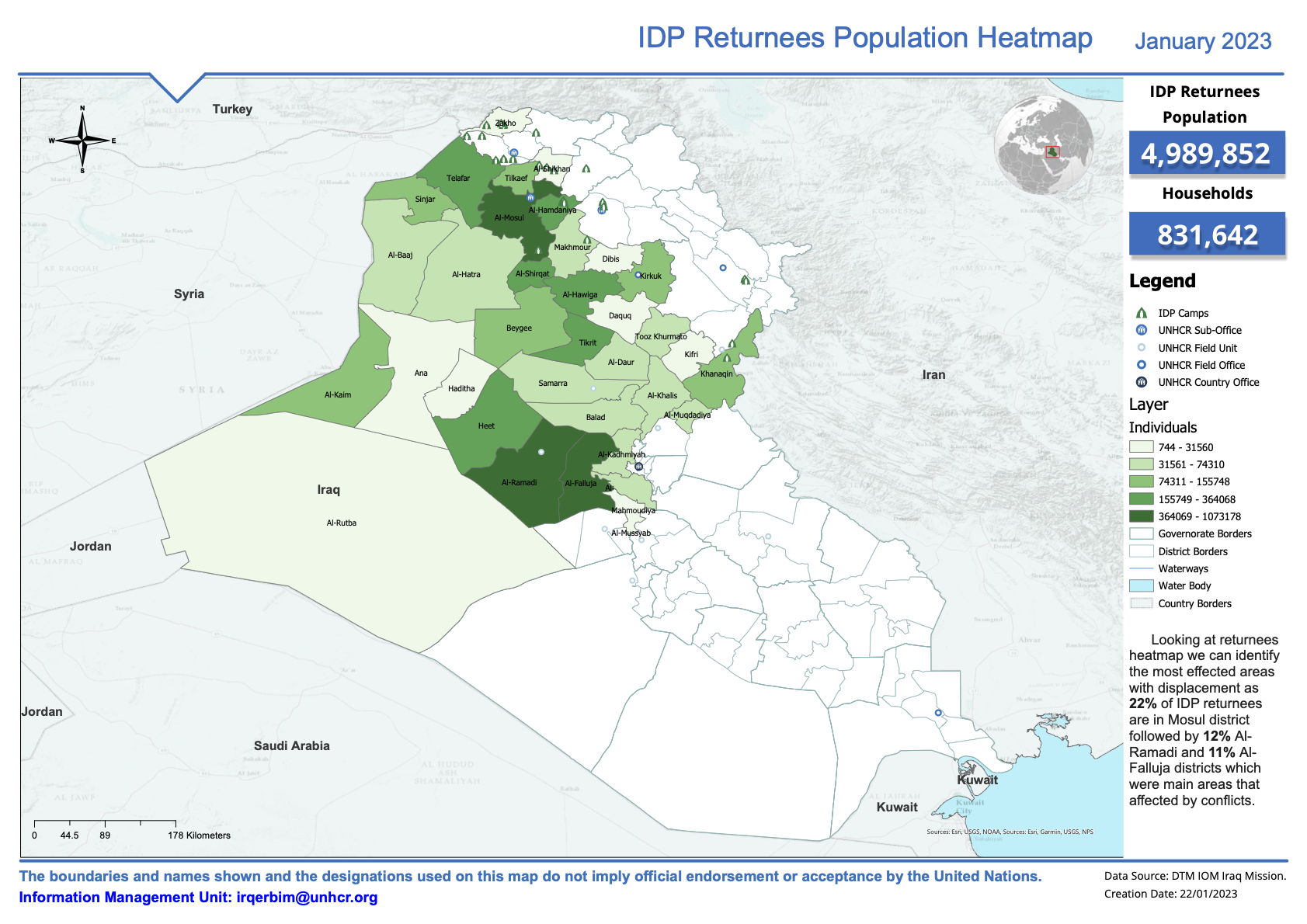
UNHCR graphic shows returning IDPs in 2023.
The Current Situation
Despite some progress since 2017, displacement in Iraq remains a fact of life for many. As of the end of 2023, approximately 1.1 million internally displaced persons are still unable to return to their original homes, and significant barriers remain for those attempting to reintegrate. Issues such as lack of housing, poor access to essential services like healthcare and education, and insufficient civil documentation impede their ability to rebuild their lives. Additionally, security concerns and the absence of basic infrastructure in areas of return discourage many from leaving camps.
In recent years, the Iraqi government has pushed to close IDP camps, urging displaced individuals to return home or integrate permanently into host communities. However, many returnees encounter unlivable conditions, including inadequate housing and vital services such as water and electricity. Some regions have seen improvements, but others remain underdeveloped, contributing to continued displacement and continued vulnerabilities.
Despite this, the UN has echoed the Iraqi government's sentiment that emergency aid to displaced people should be wound down. According to Refugees International, "the UN has begun transitioning its response in Iraq from a humanitarian response to a development response." NGOs fear that this could cause gaps in delivering vital aid to these populations and could result in worsening poverty for these individuals.